February 16, 2026


Every project starts the same way for me. I can see the destination. Maybe it's a SaaS platform, a legacy migration plan, a project blueprint, or a winning proposal. After 30 years of building systems, I know what good looks like. But the path from here to there? That's often abstract, disorganized, full of gaps I can sense but can't name yet.
That's the challenge every experienced professional faces. "The devil's in the details" is what prevents us from starting on our vision. You have the expertise, but translating what's in your head into something tangible, comprehensive, and production-ready — that's where the real work lives.
AI should be the thing that closes that gap. But most people aren't using it that way. They're treating AI like a research assistant or a snippet machine — a function here, a paragraph there, a quick analysis to compare options. Programmers grab a code block. Executives get a draft summary. It's useful, but it's shallow. It's the modern equivalent of dictating a letter to a secretary: you speak, they type, you proof it, done. Transactional.
What most people aren't doing is handing AI the entire abstract vision — the messy, sprawling, half-formed idea — and collaborating through it end to end. That reluctance makes sense. Communicating something that complex to a machine feels daunting. It's easier to ask for snippets than to try articulating an entire system that only exists in your head. Whether it's code, a proposal, or a book, breaking off small pieces feels safer than committing to the whole thing.
Here's the irony: the people who benefit most from AI collaboration are often the ones whose thinking is the least organized. You ramble. You jump between ideas. You've got a dozen threads running in different directions. Good. AI can take that chaos and find the structure in it. The problem isn't that your ideas are messy. The problem is you're only asking AI to clean up fragments instead of helping you assemble the whole picture.
But fragments don't become systems on their own. To go from abstract vision to something that holds together at scale, AI needs full context: business requirements, infrastructure constraints, architectural decisions, operational realities. Without that, you get output that compiles but doesn't cohere.
Over the past month, I've worked through four production projects using AI as a collaborator — a SaaS platform, a project blueprint, a legacy migration plan, and a government RFP response. Through that concentrated work, I've realized that effective AI collaboration requires you to play two roles simultaneously. Most people only play one.
The Two Roles
The Architect sees the big picture. You bring the roadmap — even if it's rough. You provide the context, the constraints, the business knowledge, the decisions that shape everything downstream. You may not have every detail figured out, but you can see the shape of the solution. You set the direction.
The Navigator steers through execution. You take AI's output and work through it in real-time — pushing back when something feels wrong, pivoting when reality doesn't match the plan, iterating until the output matches what your architect's eye knows is right. You don't just accept what AI produces. You navigate it toward something that actually works.
AI is the engine. You're both the architect who designed the route and the navigator who steers through the terrain.
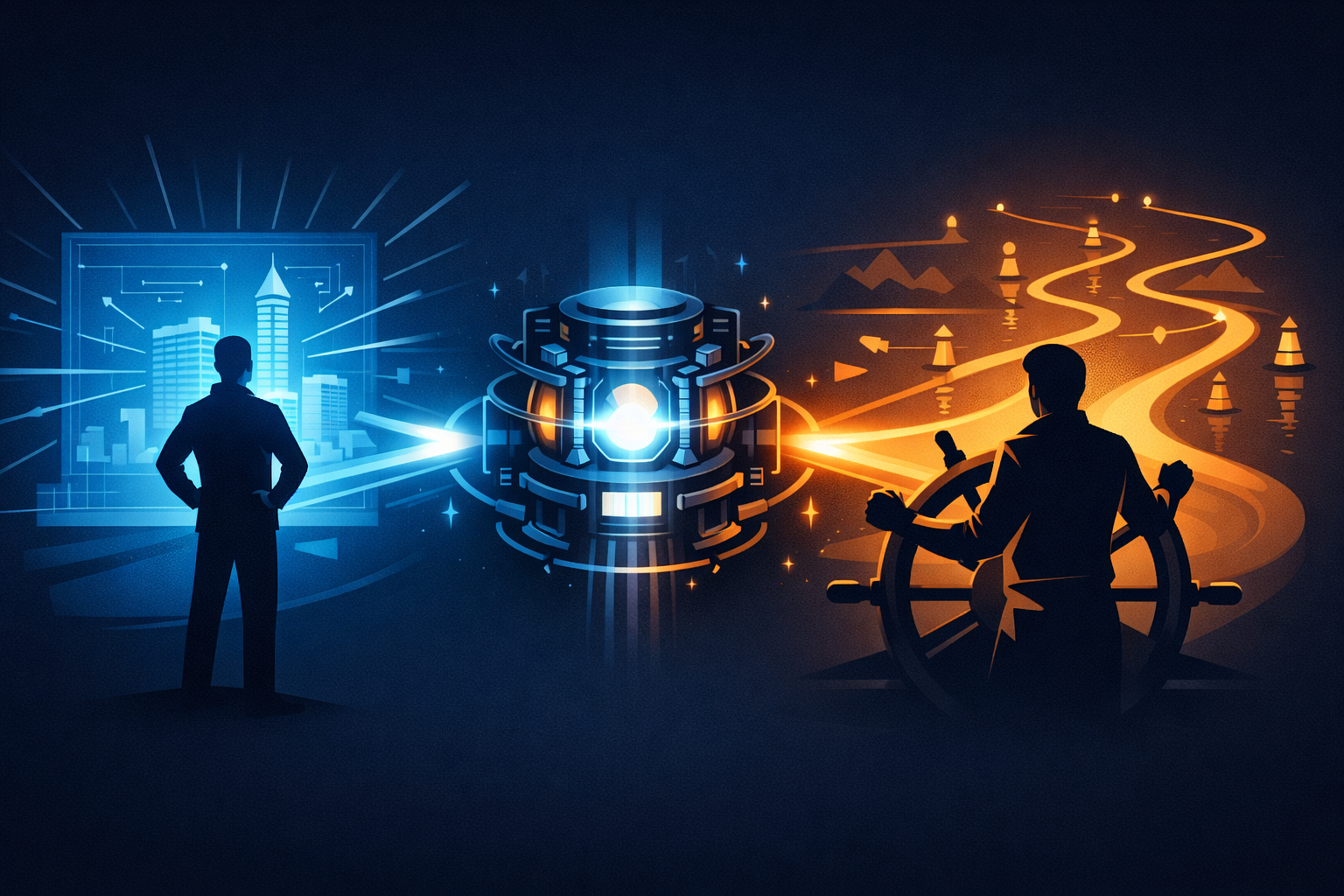
The Architect: Setting the Direction
The Architect's job is to ensure AI is solving the right problem within the right constraints. This is where your experience and professional judgment come into play — before AI generates a single line of output.
Giving AI the full picture, not just a task. When I started building FileCourier, my first message laid out the infrastructure direction: Aurora PostgreSQL for the database, API Gateway and Lambda for the REST API. I asked for language recommendations and whether tools like Replit could expedite development. AI came back with Aurora Serverless v2 for cost efficiency, Node.js with TypeScript, and SST as the infrastructure framework — and steered me away from Replit for this particular use case, since the architecture needed to be AWS-native from the start. As the collaboration progressed, I layered in operational constraints: no staging environment, database private and accessible only via Lambda. Each piece of context narrowed AI's output toward solutions that fit my reality.
| ✓ Architect | ✗ Passenger |
|---|---|
| "I'm planning to use Aurora PostgreSQL, API Gateway, and Lambda. What language and tools do you recommend?" | "Build me an API." |
Starting with strategy, not writing. On the government RFP, I uploaded the full document and asked: "Should I even submit a proposal for this?" Anyone who's written a proposal knows the writing is the easy part. Understanding what the evaluators care about, positioning against invisible competitors, deciding which weaknesses to address head-on — that's the real work. The Architect does that work before the first word is drafted.
| ✓ Architect | ✗ Passenger |
|---|---|
| "Should I pursue this? What are the risks and competitive dynamics?" | "Write me a proposal for this RFP." |
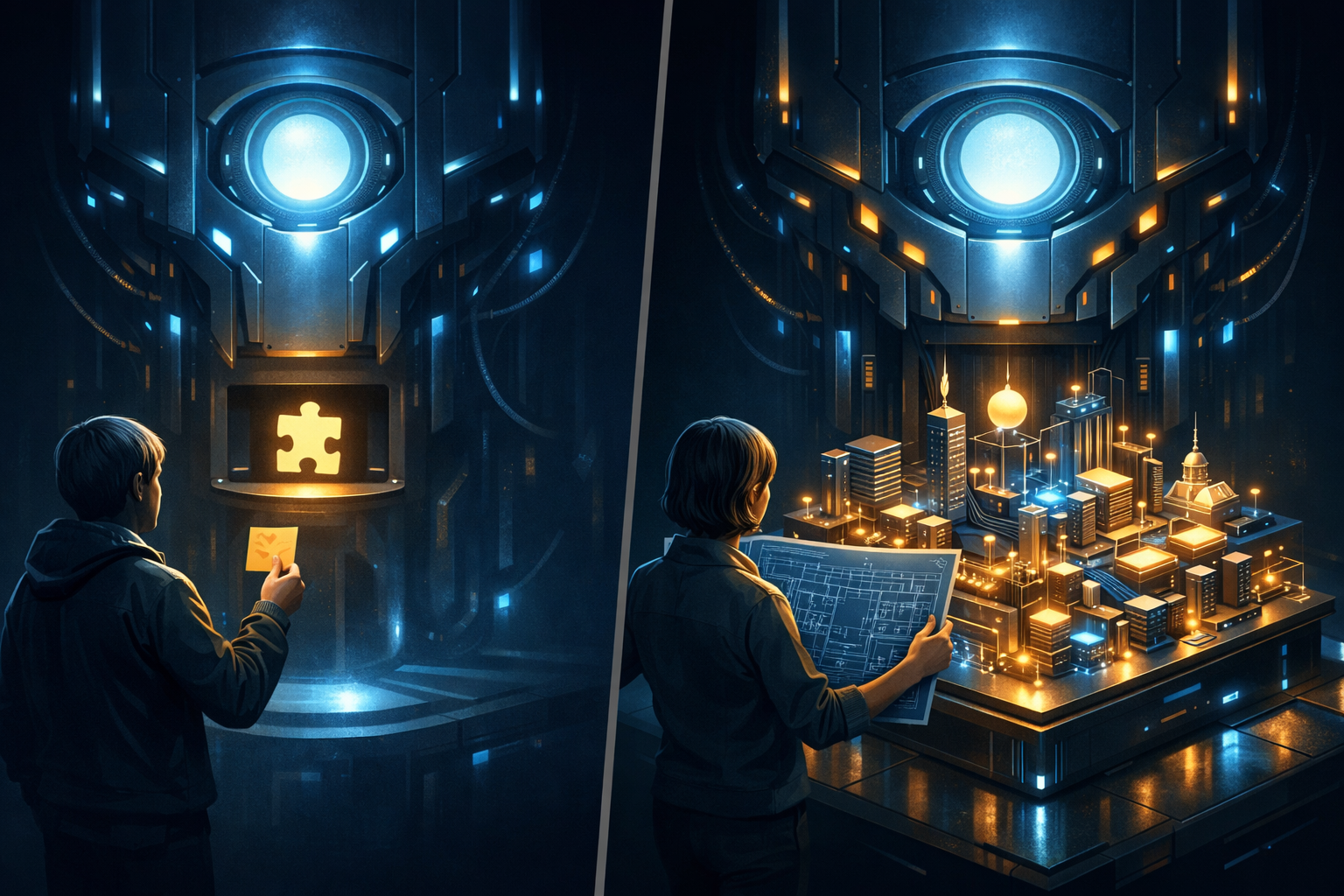
Making architectural decisions AI can't make. On a legacy migration for a ColdFusion-based CMS platform built for the law firm industry, AI would have happily recommended a modern decoupled architecture — REST API backend, separate frontend. But this was a monolith where everything rendered server-side. The AJAX calls weren't a true REST API. Converting the code to Python and simultaneously converting the architecture would stack two massive transformations on top of each other. So I chose Flask specifically because its server-side rendering mirrors how ColdFusion works — keeping the migration focused on the code, not redesigning the entire architectural pattern. Same logic for choosing raw psycopg2 over an ORM: ColdFusion uses inline SQL through cfquery tags, so a 1:1 translation to raw database calls keeps the conversion predictable. These decisions came from understanding the system being migrated from, not just the system being migrated to.
The Architect is a visionary. You can see the starting point and the end point. You could whiteboard the whole thing — the systems, the flows, the technology choices. But the path between those two points? It's messy. There are gaps you can sense but can't name yet. Pitfalls you won't see until you're in the middle of it. The Architect's job isn't to have every detail figured out. It's to describe the entire idea — even if it's disorganized, even if it's rough — and give AI enough context to start filling in what you can't see from the whiteboard.
The Navigator: Steering Through the Mess
Here's where most people fall short. They set up the conversation well enough, but then accept whatever AI produces. They don't navigate. And navigating is where abstract becomes tangible.
Catching what AI misses. During the FileCourier build, I needed multiple user roles: Admin, Developer, Manager. Since I hadn't specified roles upfront, AI created separate tables for admin users and regular users. It worked. But would it scale? Would it be maintainable when we added new roles? Not a chance. When I provided the context I actually wanted — a normalized model with a roles lookup table — AI implemented it correctly. The code wasn't broken. The architecture was. And AI had no way of knowing that without me catching it.
Pivoting when the plan hits reality. On a ColdFusion-to-Python migration, AI generated 102 tasks. That's not a plan — that's noise. AI doesn't mind granular. It can generate and track hundreds of line items without breaking a sweat. But humans have to actually execute those tasks, and 102 items is overwhelming — developers see a list like that and don't know where to start. So I analyzed the output, identified where tasks could be grouped and consolidated, and gave AI specific direction on how to restructure them into logical work units. Four iterations later, we had 19 meaningful tasks a team could actually execute against. AI also suggested converting stored procedures before the application tiers. I redirected: developers need full application context first. AI agreed immediately — it just didn't have that operational insight.
Demanding honesty, not validation. On the proposal, I asked AI to play red team: "What are the weaknesses? Where would a competitor attack us? Be brutal." It identified three vulnerabilities I hadn't fully confronted. Requesting criticism instead of comfort made the final product significantly stronger.
Injecting what only you can bring. AI generates professional-sounding documents all day. The parts that actually differentiate — the ones that make a client say "this team gets it" — come from you. On the proposal, it was a housing analogy that reframed the value proposition. On the carwash fundraising project, Raisely's platform terminology didn't match how the client thought about their own system — "campaigns" and "profiles" meant different things to them than what Raisely intended. AI had no way of catching that disconnect. I did, because I understood the client's world, not just the platform's documentation. Your authentic voice and your client knowledge are things AI cannot generate.
Iterating until abstract becomes real. That same carwash fundraising project started as a two-page summary — rough requirements, gaps everywhere. I needed to validate whether Raisely was even the right platform, untangle the terminology confusion, and map out how integration would actually work against their existing infrastructure. So I used AI to iterate through use cases, identify gaps in the API, and build out alternative approaches if Raisely couldn't deliver what we needed. From there, a business proposal, technical integration guide, executive presentation, risk assessment, and 46 actionable tasks. That didn't happen in one pass. The proposal went through four versions. Each iteration caught inconsistencies, filled gaps, and pressure-tested assumptions. What started as a vague requirement became a comprehensive blueprint — from complex gap analysis to technical spec to integration schedule — all within 24 hours.
At its core, the Navigator's job is to bring the human element. AI can build an entire application, generate a complete migration plan, draft a full proposal. But humans still have to use what comes out the other side. Developers have to execute the tasks. Clients have to understand the proposals. Teams have to maintain the code. The Navigator keeps that in mind at every step — not just whether the output is technically correct, but whether real people can work with it. Maybe someday, sooner than we think, everything end to end will be done by AI. But today, humans are still in the loop. And the Navigator is the one who never forgets that.
Why You Need Both
An Architect without a Navigator sets a great direction and accepts mediocre execution. The code compiles but the assumptions are wrong. The documents look professional but the task breakdown falls apart on contact with a real team.
A Navigator without an Architect catches errors but never gave AI the context to produce good output in the first place. They spend their time fixing problems that better direction would have prevented.
The two roles weave together throughout every session. On any given project, I'm the Architect when I set the constraints and make technology decisions, then the Navigator when I catch a flawed database design or consolidate 102 tasks down to 19, then back to the Architect when I redirect the positioning angle, then the Navigator again when I push AI to red-team its own work. That fluid switching is what collaboration actually looks like.
From Abstract to Tangible
What makes this collaboration model meaningful isn't speed — though it is efficient. It's the ability to take something abstract and turn it into something tangible and production-ready, with intellectual rigor at every step.
This is the gap between snippets and systems. Anyone can ask AI to generate a function or draft a paragraph. But a vague client summary becoming a comprehensive blueprint with 46 actionable tasks? An idea becoming a deployed SaaS API with a 27-table schema? A dense RFP becoming a strategically positioned proposal backed by competitive analysis? That requires full context, sustained collaboration, and both roles working together.
The real unlock isn't doing things faster. It's being able to think deeply about multiple complex problems at once, with a collaborator that can keep up with your pace and execute at the level of detail your vision demands.
The Craft Paradox
Here's something I didn't expect: the people who struggle most with this collaboration model aren't beginners. They're the veterans. The programmer with 20 years of production code under their belt. The proposal writer who's authored thousands of documents. The ones who've been doing the work — hands on keyboard, line by line — for decades. You'd think they'd take to AI collaboration fastest. They don't.
I get it. When you've spent decades mastering a craft, there's identity tied to the act of doing it. Writing code line by line isn't just a means to an end — it's how you think. Drafting a proposal from scratch isn't busywork — it's where your expertise lives. Handing that to AI feels like giving away the thing you've spent your career building.
So what happens? They use AI for snippets. A function here. A paragraph there. It's like taking a power saw, cutting a quarter of the way through, then setting it down and finishing with a hand saw. You own the tool that could do the whole job. You only trust it for the easy part. The rest, you do by hand — because that's what you know, and because the craft feels like it should be hard.

Here's what they're missing: AI doesn't replace the craftsperson. It promotes them. The programmer who lets AI handle the mechanical coding can focus on architecture, system design, the decisions that shape everything downstream. The proposal writer who lets AI handle the drafting can focus on strategy, positioning, the judgment calls that win contracts. AI is the thing that moves you from practitioner to architect — if you let it.
But nobody gets there by asking AI for snippets.
The Expertise Multiplier
This is the part that changes the equation. AI doesn't diminish your experience — it multiplies it exponentially.
A junior professional using AI gets help with basic tasks. That's real. But someone with deep experience in architecture, security, and business context? AI multiplies everything they know. The Architect role gets stronger with every year of experience. The Navigator role gets sharper with every project where you've caught a hidden assumption or pivoted past an obstacle.
AI gives your experience a vehicle it never had before.
The Bottom Line
AI is not a magic wand. It's an engine that goes exactly where you steer it.
If you only play the Architect, you'll set a great direction and accept mediocre execution. If you only play the Navigator, you'll fix problems that better direction would have prevented. The people getting exceptional results are the ones who play both roles — setting the direction with context and constraints, then navigating through execution with judgment, pushback, and relentless iteration.
It's about taking what's in your head — abstract, maybe disorganized, but rooted in real expertise — and turning it into something tangible, production-ready, and built to last. That's what the Architect and the Navigator do together.
About WAM DevTech's AI-Accelerated Development
We use AI to accelerate the mechanical work of coding and analysis. Senior architects provide the context, review, and judgment that keeps your systems secure and stable. The result: faster delivery, lower costs, and code you can trust. Learn more about our AI-Accelerated Development approach.
Need an Architect for your AI initiatives?
Have complex systems that need experienced guidance?
We bring 25+ years of architecture experience to AI-accelerated projects. Let's discuss whether our Architect-Navigator approach fits your modernization or development needs. 15 minutes, no pitch.
Jae S. Jung is the founder and CTO of WAM DevTech, a consulting and development firm specializing in cloud architecture and legacy system modernization for enterprise-scale organizations and government contractors. With over 25 years of experience building and leading distributed development teams across North America, Europe, South America, and Asia, he helps organizations navigate the intersection of technical infrastructure and operational effectiveness at scale.
Share Article


