Site Renovation
April 20, 2026
I Wanted to Launch a Site Renovation Service. Then I Noticed Something.
 By Jae S. Jung
  By Jae S. Jung
 The idea was simple. Help businesses with aging websites modernize them without starting from scratch. Assess what's there, identify what's salvageable, build what needs to be new. A service called Site Renovation, straightforward enough on paper. Except as I started putting it together, something kept nagging at me.
I could build the demos.
Not wireframes or Figma screens or a PDF of a mockup. Actual working sites. Real pages, real design matching the client's brand, hosted on real infrastructure, clickable on any phone in a matter of days rather than months. And not just static marketing sites either. Functioning applications with real databases and containers spun up, CMS-powered platforms where a client could log in and manage content. The full thing, working, before anyone committed to anything.
That was new. And once I noticed it was possible, I couldn't un-notice the bigger question behind it. Why did software development ever work the other way?
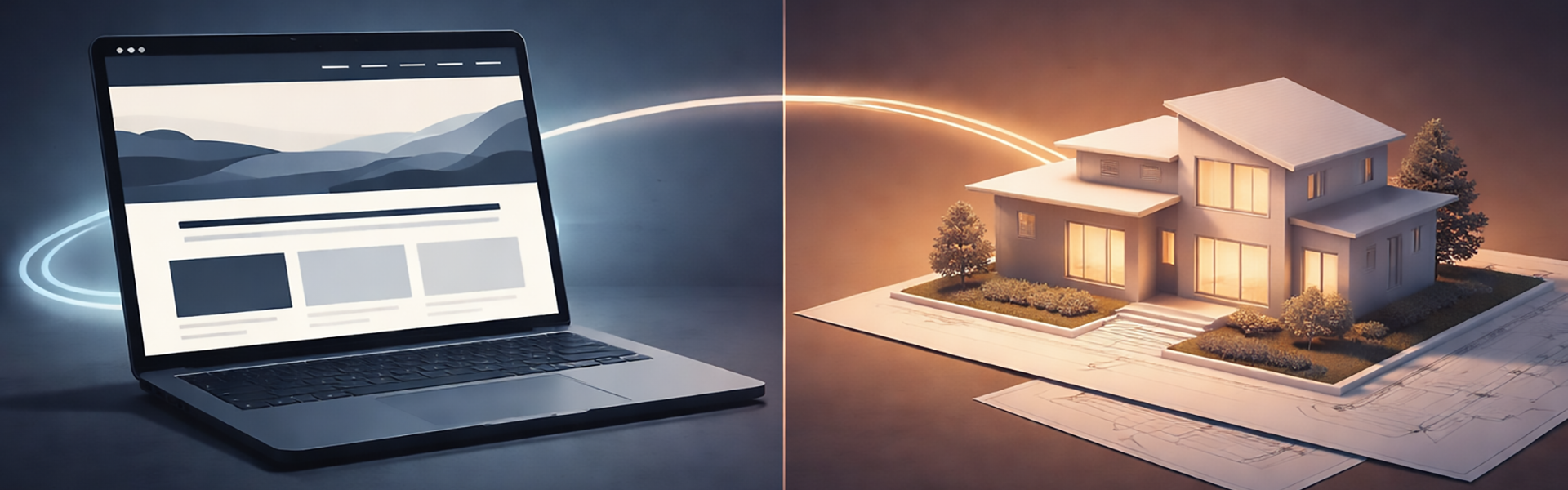
I came to software from an engineering background. In college I used AutoCAD to design structures before anything physical got built, and that was just how the field operated. You modeled the thing, refined the model, then committed the materials. Nobody questioned it because the alternative was obviously absurd. You wouldn't commit steel and concrete to a structure you hadn't seen yet. You wouldn't pour a foundation based on a written description.
I noticed this pattern everywhere the moment I started looking for it. When I bought a house, I walked through a model home before signing anything. Stood in a real kitchen, opened real closets, knew what I was buying. When neighbors have had decks or pools built, the contractors show up with SketchUp renderings showing exactly what the backyard will look like, where the steps land, the angle of the pergola. Automakers build full-size clay sculptures of cars before a single production line is tooled, so designers can walk around them and run their hands along the curves. Architects hand clients 3D models of buildings that don't exist yet and let them fly through the interior on a screen.
Every mature industry does this. Modeling isn't a nice-to-have. It's the default. Software was the outlier.
Not because nobody tried. The industry has been attempting to fix this for years — wireframes, Balsamiq, Figma, InVision, Sketch, clickable prototypes, design systems in Storybook. A whole generation of tools built on the premise that if you could just show the client something, you'd reduce the risk of committing. They all fell short in the same way.
A wireframe tells you where the button goes but not what happens when you click it. A Figma prototype walks you through a flow but doesn't show you real content, real performance on your actual phone, or what the system feels like when a real database is behind it. The closer any tool got to the real product, the more expensive it got to produce, and high-fidelity mockups meant design teams and weeks of work. None of it was ever the actual working product. It was always an approximation that asked the buyer to fill in the blanks with their imagination.
That's not what happens in a model home. You don't imagine the kitchen. You stand in it.
I saw this firsthand when we responded to an RFP from Chippewa County, Michigan. Rather than writing a proposal and attaching mockups, we built the working system itself. Real headless CMS, real infrastructure, real content populated from their own public data, five days from start to live demo. During the interview, I walked the evaluation committee through a functioning site with Payload CMS behind it — logging in, managing content, navigating the live pages in real time. We were awarded the contract. That wasn't luck. That was modeling, finally working the way it works in every other field.
Here's the fair question that comes next. If the demo is a working system, why isn't it the final product? Why not just ship it?
Because the demo isn't the product. The demo is the starting point for a conversation that couldn't happen before.
The system we built for Chippewa was built cold, from a public RFP document alone, with no discovery sessions, no interviews with the staff who actually use the system every day, no understanding of how the health department coordinates with the sheriff's office, no sense of which workflows are painful and which ones are working fine. What happens when a department editor needs to publicize a road closure at 9 p.m. on a Friday? How does the county clerk's workflow differ from the treasurer's? Which PDFs need tagged accessibility fixes and which ones are already compliant? How do staff want to be trained, and what does content migration actually look like for the records that matter most?
None of that is in an RFP. None of it can be. It only surfaces in conversation with the people who live inside the system every day.
Without a working model, most of the client-vendor conversation gets spent trying to verify the vendor can do the thing at all. Can you build it? Can you host it? Can you make it secure? Is the architecture sound? Those questions eat up the discovery process because they have to. The risk of getting them wrong is the biggest risk on the table.
With a working model in front of you, those questions are already answered. The technology risk is retired before the contract starts, which means the conversation can finally be about what actually determines whether the final product is any good. The people. The workflows. The edge cases. The integrations. The training.
The model doesn't replace the discovery. It earns the right to have a better one.
That's the part most people miss when they first see this in action. They see the speed and assume the implication is that we can skip the slow parts. The implication is the opposite. We can finally spend the slow parts on what actually matters, because the fast parts aren't where all the risk lives anymore.
Web buyers have been asked to commit first and see later. That was the constraint, and the constraint is gone.
For the Website Renovation tier, we'll build up to 3 fully functioning concept sites — different design directions, different interpretations of your brand — and send you the links within 24 to 48 hours. Real sites, hosted on our domain, viewable on any device. You pick the direction you love, or you walk away. No cost, no obligation.
For the Website + CMS tier, the concept goes further — a fully functioning demo with the CMS connected, so you can log in, test content management, and understand exactly what you're buying before signing anything.
You can see it first now. And you should expect to. The conversation that happens after you've seen it is where the real work begins.
This is part of what I've been writing about in The Architect and The Navigator, my book on AI collaboration for experienced practitioners. The model is the artifact. The collaboration it enables is the actual product.


We'll build fully functioning concept sites for your business and send you the links within 24 to 48 hours. Pick the direction you love — or walk away.
Jae S. Jung is the President of WAM DevTech, Inc., a consulting and development firm specializing in AI-accelerated software development, legacy system modernization, and enterprise architecture. With nearly 30 years of experience building and leading distributed development teams, he helps organizations navigate the intersection of technical infrastructure and operational effectiveness.